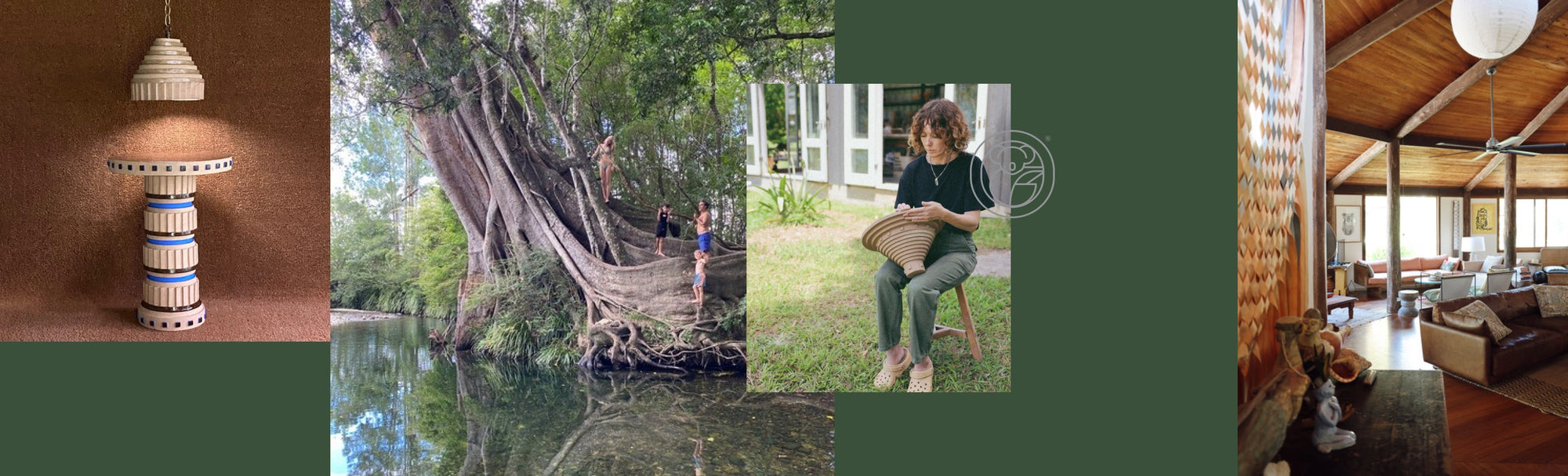
The intersections between spirit, nature, and the occult are the inspirations for the drawings, textiles and ceramics of multidisciplinary artist Lisa Lapointe, who lives with her family on the mid-north coast of Australia’s New South Wales, an area renowned for its natural beauty. Living and working in such a tranquil environment, Lisa’s connection to nature continues to influence her artistic practice, through which she likes to explore and create a bridge between the known and the unknown. We asked her to tell us more:
What are your fondest memories of spending time in nature?
When I was a child, my family had a property on the Hawkesbury River, surrounded by National Park. We used to spend a lot of time there. Having access to the river and the mountains and the bush gave us many ways to engage with nature: bonfires on the river at night, and using our old beat-up tinny to explore caves, mangroves and hidden waterways. I loved bushwalking and exploring our property on my little Honda 80.
What’s your favourite thing to do in nature?
We are very lucky to live on the mid-north coast of NSW and are surrounded by countless beautiful swimming holes. I love taking my kids swimming at our favourite waterhole on the way home from school. It’s such a lovely way to reconnect at the end of a day and bring our family back together after being apart.
How does spending time in nature influence your mental health? Can you think of a specific experience where this effect was particularly strong?
I feel we’re now in a time where we all live in such different realities. Due to technology, the chaos of limitless online content has disconnected and fragmented our shared reality. Nature, more than ever, is our baseline: the one thing that can truly connect our realities. When in nature we are able to connect with each other, but more importantly to ourselves, be it through swimming, walking or simply just listening. It’s restorative; it’s the essence of our humanness.
How do you bring nature into your home?
Our home is nature. We live in a round house made of timber, glass and stone, built with beautiful raw materials by a husband and wife in the late 1970s. It’s nestled between
the river and the mountain. I do have a love for extra large crystals and have them throughout our house.
What is your favourite natural scent, and why?
I love the smell of an outdoor fire. I love sandalwood and the smell of leather. I’m a Taurus, so perhaps these smells speak to my earthy nature.